LLM-Judge ↔ Human Alignment
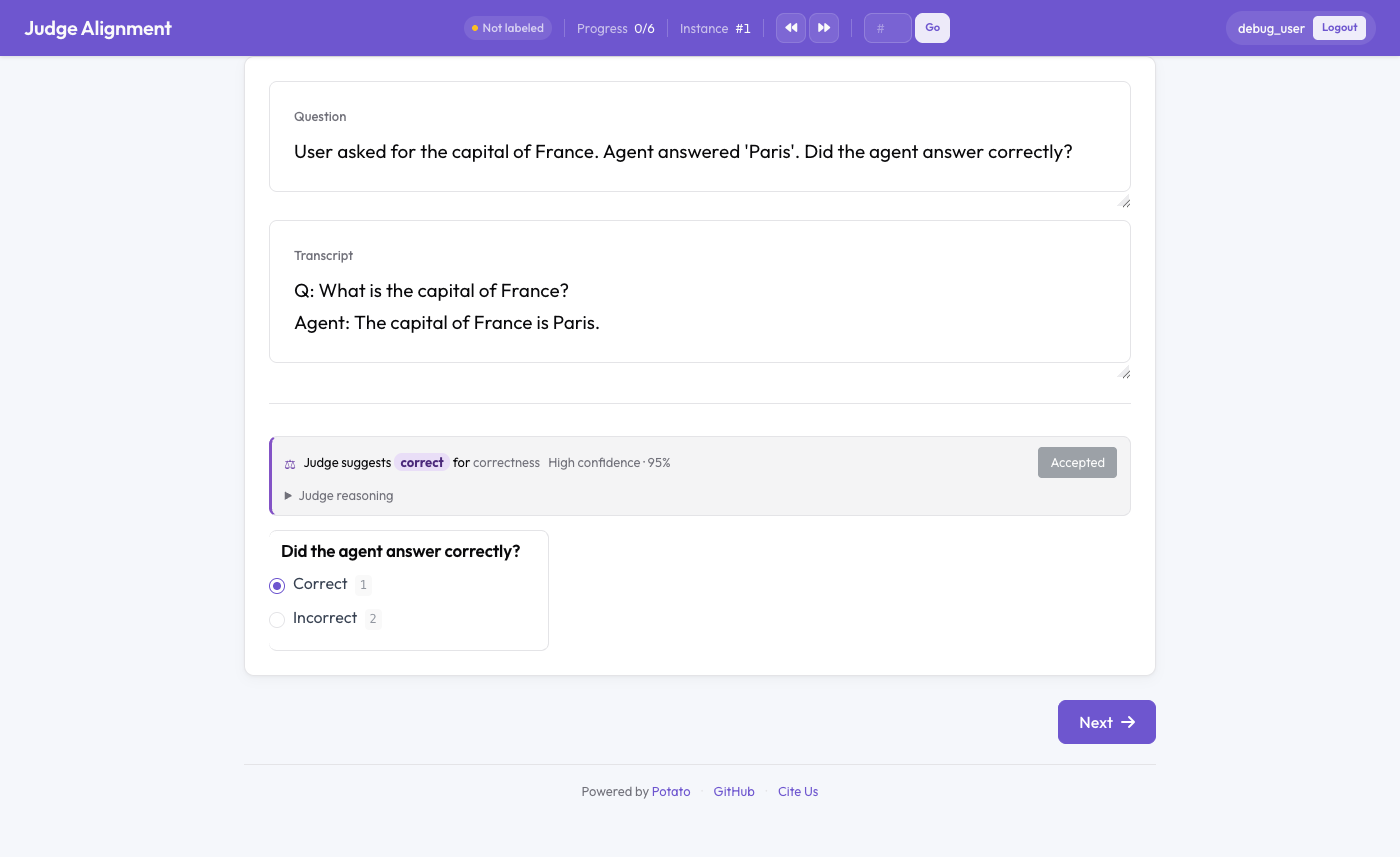
Measure and calibrate how well an LLM judge agrees with your human gold labels. Potato runs a configurable LLM-as-judge over instances your annotators have labeled, computes Cohen's κ + a confusion matrix + a disagreement list, and tracks κ as you edit the judge rubric. With inline mode on, the judge's verdict is shown beside the human's label during annotation, with a running κ.
This is the standard "align your judge to ~100–200 gold labels" workflow (LangSmith Align Evals, Databricks, Evidently): collect human labels → run the judge → inspect disagreements → refine the rubric → re-run until κ is high.
Configuration
# The judge uses the standard AI endpoint machinery.
ai_support:
  enabled: true
  endpoint_type: "ollama"        # ollama (keyless/local) | openai | anthropic | vllm | ...
  ai_config:
    model: "llama3.2"
    temperature: 0.0
    # openai/anthropic: add api_key: "<key>"

judge_alignment:
  enabled: true
  schemas:
    correctness:                 # per annotation-scheme rubric (editable)
      rubric: >
        Label 'correct' only if the agent's answer is factually right and fully
        satisfies the request; otherwise 'incorrect'.
  few_shot:
    enabled: false               # seed the judge prompt with gold examples
    max_examples: 4              # drawn from high-agreement human labels
    min_agreement: 0.8
  inline:
    enabled: true                # show judge verdict beside the human label
    schemas: [correctness]
    compute_on_demand: false     # call the judge live when no cached verdict exists
Scope: single-choice categorical schemes (radio, select, likert). If
judge_alignment.schemas is set, only those schemes are judged; otherwise all
categorical schemes are.
Running the judge
The judge is run from the admin API (predictions are cached per prompt version, so re-runs are cheap):
# Generate / refresh judge verdicts over human-annotated instances
curl -X POST localhost:8000/admin/api/judge-alignment/run \
  -H "X-API-Key: <admin-key>" \
  -H "Content-Type: application/json" \
  -d '{"max_per_schema": 200}'
To calibrate, pass an edited rubric — this creates a new prompt version so you can compare κ across rounds:
curl -X POST localhost:8000/admin/api/judge-alignment/run \
  -H "X-API-Key: <admin-key>" -H "Content-Type: application/json" \
  -d '{"rubrics": {"correctness": "Stricter rubric text..."}}'
κ drift trend
The dashboard's Prompt versions card plots a sparkline of κ across prompt
versions in the order they were created, with a direction badge — improving,
declining, or stable — and the first→last delta. Each schema has its own
prompt versions, so the trend is per schema; with several, the card shows the
schema with the most versions and the report's kappa_trends has the rest. This makes calibration drift visible at a
glance: you can see whether successive rubric edits (or auto-calibration rounds)
are actually raising agreement, or whether a "fix" quietly regressed it.
Automated calibration (corrections → few-shot)
Instead of hand-editing the rubric, auto-calibrate: the instances where a human corrected the judge (human label ≠ judge label) are exactly where it's wrong, so they make the most informative few-shot examples. One call re-runs the judge with those corrections injected into the prompt and reports the new κ:
curl -X POST localhost:8000/admin/api/judge-alignment/autocalibrate \
  -H "X-API-Key: <admin-key>" -H "Content-Type: application/json" \
  -d '{"max_corrections": 5}'
This mirrors LangSmith's "human corrections become few-shot examples", grounded in Potato's κ tracking. Per schema it returns the base vs new prompt version, base vs new κ, the delta, and whether κ improved:
{"schemas": {"correctness": {"base_kappa": 0.42, "new_kappa": 0.71,
  "delta": 0.29, "improved": true, "n_corrections": 5,
  "new_version": "v_…"}}, "improved_count": 1, "total": 1}
Leakage guard: when judging an instance, any correction for that same instance is excluded from its few-shot set — the judge never sees the answer to the item it's grading. The new prompt version appears in the report's prompt-version history alongside manual rounds.
The alignment report
GET /admin/judge-alignment            # JSON
GET /admin/judge-alignment?format=html  # rendered page
GET /admin/judge-alignment?prompt_version=v_abc123  # a specific version
X-API-Key header). The report shows, per schema:
- Cohen's κ + Landis–Koch interpretation, agreement rate, and n compared,
- a confusion matrix (rows = human gold, columns = judge),
- a disagreement table (instance, human, judge, confidence, judge reasoning),
- prompt-version history with mean κ per version, so calibration progress is visible.
Human gold is the majority vote across annotators for each instance. An instance where the vote is tied has no gold and is left out. The running κ shown during annotation counts each annotator's latest label on each instance once, however many times it was saved.
Judging beyond single-choice (span & free-text)
The judge isn't limited to radio/select/likert. potato.ai.judge routes by
schema type (judge_mode):
- Span schemas (
span,error_span,coreference) —JudgeService.judge_spansasks the model to extract labeled spans (exact substrings + labels), maps them to character offsets (repeated text → distinct offsets), and validates labels against the schema. Score against human spans withscore_spans(predicted, gold, iou_threshold=0.5)→ IoU-matched precision / recall / F1 / mean IoU (the same matcher asjudge_calibration.metrics.span_prf).
res = service.judge_spans(iid, schema, text)        # {"spans": [...], "reasoning": ...}
score_spans(res["spans"], human_spans)              # {"precision","recall","f1","mean_iou",...}
- Free-text schemas (
textbox,text,text_edit) —JudgeService.judge_freetextrubric-scores a free-form response along one or more feedback dimensions (continuous0–1,boolean, orcategorical), à la LangSmith:
dims = [{"key": "helpful", "type": "boolean"},
        {"key": "fluency", "type": "continuous"}]
service.judge_freetext(iid, schema, text, dims)     # {"scores": {...}, "reasoning": ...}
quality score. Continuous values are clamped to
[0, 1]; booleans/categoricals are coerced and (for categorical) fuzzy-matched to the
declared labels.
Span agreement uses IoU-F1 (not κ); free-text judging is reference-free (the judge produces the feedback scores).
Inline mode
With inline.enabled, each annotation page shows the judge's cached verdict for
the instance (label + confidence + expandable reasoning) and a running κ for the
task. "Accept" fills the matching choice. Each human save records a human↔judge
comparison feeding the running agreement. Set compute_on_demand: true to call
the judge live when no cached verdict exists (slower; otherwise pre-run the batch).
How it works (reuse)
- The judge call goes through the same
ai_supportendpoint as every AI feature. - Few-shot calibration examples are drawn from high-agreement human labels (the ICL example selector), always excluding the instance being judged (no leakage).
- κ is computed by
potato/agreement.py(judge vs. human gold as two annotators). - Predictions persist under
{output_annotation_dir}/judge_alignment/keyed by prompt version; the LLM calls are cached.
Judge eval cards: bias & robustness (the axis beyond κ)
Agreement (κ) alone can hide a biased judge — research finds style/length bias dominates and is invisible to κ. The dashboard's Judge eval cards panel adds the second axis per schema and packages both into a portable certificate:
- Verbosity / length bias — does the judge assign the positive class to longer outputs more than humans do? (judge minus human positive-class length gap).
- Confidence calibration — does stated confidence track actual correctness vs human gold? (expected calibration error + reliability buckets).
- Position-swap consistency — for order-sensitive judging, how often the verdict flips when option order is reversed (a runnable probe).
Each card shows a verdict — trustworthy / use with caution / needs review — with
the specific concerns listed. See potato/server_utils/judge_bias.py.
A card with no human/judge pairs behind it reads not yet measured, and
carries agreement.n: 0. Every concern above comes from a measurement, so
before anyone has annotated anything there are none to raise — which is not the
same as a judge that has been checked and found sound.
Soft-label / perspectivist export
Disagreement is signal, not just noise. GET /admin/api/perspectivist exports, per
item, the full label distribution, a normalized-entropy ambiguity flag, and
per-annotator perspectives (majority vs minority rate) — the soft-label /
disagreement-aware format, alongside (not replacing) Dawid-Skene consensus. See
potato/server_utils/perspectivist.py.
Notes & limitations
- v1 calibration is manual (edit rubric + re-run); automated prompt optimization is out of scope.
- Scope is single-choice categorical schemes. Span/free-text judging is future work.
- Run the judge over a focused gold set (≈100–200 labeled instances) for a stable κ.
Related
- Agent Traces, Three-Pane Trace Eval, Trajectory Correction
- The
/admin/iaapage (human-vs-human inter-annotator agreement) is the sibling report.