Trajectory Correction → SFT/DPO Training Data
The trajectory_edit annotation schema lets annotators rewrite the steps of an agent trace —
fix a wrong reasoning step, correct a typo'd tool call, or strengthen the final answer — and saves
the corrected trajectory alongside the original. The trajectory_correction exporter then turns
each (original, corrected) pair into supervised fine-tuning (SFT) targets and DPO preference
pairs.
This is the editing counterpart to Trajectory Evaluation (which scores steps). It mirrors Labelbox's "Agent Trajectory Editor" and Datadog's "edited outputs" — the dominant workflow for converting agent eval into training data.
Quick start
python potato/flask_server.py start examples/agent-traces/trajectory-correction/config.yaml -p 8000
See examples/agent-traces/trajectory-correction/ for the full runnable project.
How it works
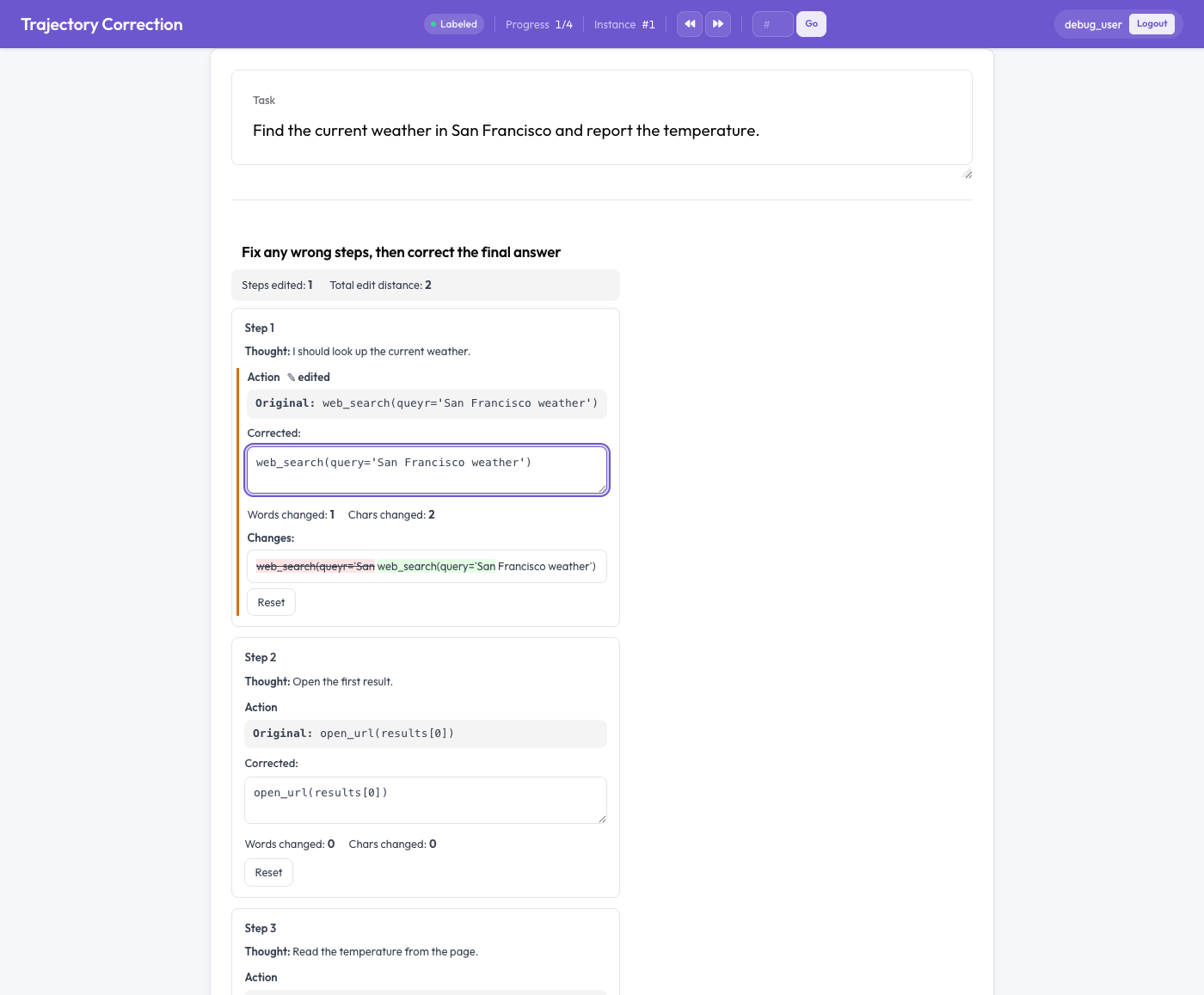
Each agent step renders as a card showing the Original text (read-only) and an editable Corrected box pre-filled with the original. As the annotator types:
- a live word-level diff highlights insertions (green) and deletions (red strikethrough),
- words/characters changed are counted, and
- an "✎ edited" flag appears on changed fields.
A "Reset" button restores the original per field. With edit_final_answer: true the final answer
gets its own editor. Nothing is required — an unedited trace simply produces no training pair.
Configuration
annotation_schemes:
  - annotation_type: trajectory_edit
    name: corrected_trajectory
    description: "Fix any wrong steps, then correct the final answer"
    steps_key: steps          # instance field holding the step list
    step_text_key: action     # the default per-step editable field
    editable_fields:          # which fields get an editor
      - action
      # - thought             # add to also edit reasoning
    show_diff: true
    show_edit_distance: true
    allow_reset: true
    require_reason_on_edit: false   # add a per-field "reason" input
    edit_final_answer: true
    final_answer_key: final_answer
| Option | Default | Description |
|---|---|---|
steps_key |
steps |
Instance field holding the step list (read from [data-instance-json]). |
step_text_key |
action |
Default editable field per step. |
editable_fields |
[step_text_key] |
Which step fields get an editor (e.g. [action, thought]). |
show_diff |
true |
Show the live word-level diff. |
show_edit_distance |
true |
Show words/chars changed. |
allow_reset |
true |
Per-field "Reset to original" button. |
require_reason_on_edit |
false |
Per-field "reason for edit" input. |
edit_final_answer |
false |
Add an editor for the final answer. |
final_answer_key |
final_answer |
Instance field holding the final answer. |
Data format
The schema reads steps from the instance under steps_key. Each step is an object whose fields
(action, thought, …) can be edited; bare-string steps are edited as the step_text_key field.
{
  "id": "traj_001",
  "task_description": "Find the weather in San Francisco.",
  "steps": [
    {"thought": "Look it up.", "action": "web_search(queyr='SF weather')"},
    {"thought": "Open it.",    "action": "open_url(results[0])"}
  ],
  "final_answer": "It is sunny."
}
Export
Run the trajectory_correction exporter. It writes three files:
trajectory_corrections.json— every record:original_trace, reconstructedcorrected_trace, and per-fieldedits(with edit distances and reasons).trajectory_sft.jsonl— one line per edited trace:{"prompt": <task>, "completion": <corrected_trace>}.trajectory_dpo.jsonl— one line per edited trace:{"prompt": <task>, "chosen": <corrected_trace>, "rejected": <original_trace>}.
Unedited traces are counted but excluded from SFT/DPO (training on an unchanged trajectory adds nothing); the skipped count is reported in the export stats and warnings. With multiple annotators, each annotator who edited a trace yields one SFT/DPO record.
Notes & limitations
- The diff is word-level (reused from the
text_editschema). For code-like tool calls with no spaces, a single token may show as wholly changed even for a one-character fix — the character-distance counter is the precise signal. - Span annotation is not applicable here; pair with
trajectory_evalif you also want per-step scoring/error taxonomy on the same trace.
Related
- Trajectory Evaluation — per-step correctness, error taxonomy, severity
- Three-Pane Trace Eval — read-only reasoning | calls | answer view
- Agent Traces — agent-trace display and evaluation patterns