Signal-Based Triage Queue
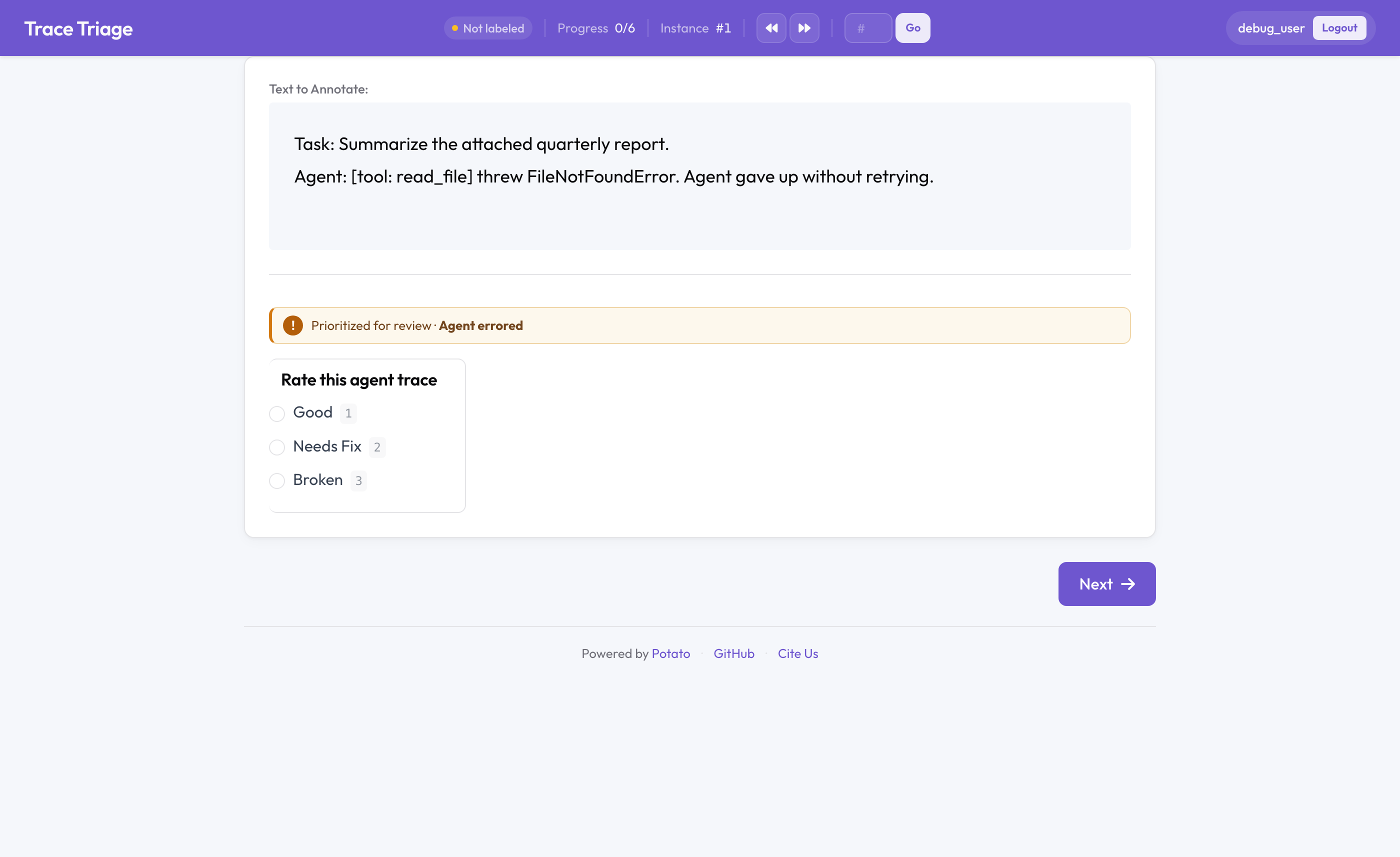
Prioritize the annotation queue by a per-item quality signal so reviewers see
the worst / most-suspect traces first, instead of annotating in arrival (FIFO)
order. The signal can be an agent error, a production thumbs-down, a low automated
score, or any custom field. It is read both for statically loaded data and for
traces ingested at runtime (webhook / Langfuse), and it surfaces in two places:
a banner during annotation and the /admin/triage-queue ranking page.
Configuration
triage:
  enabled: true
  order: desc            # high priority first (default); 'asc' = low first
  default_priority: 0    # items matching no rule
  show_badge: true       # banner during annotation explaining the priority
  rules:                 # evaluated in order; highest matching priority wins
    - name: "Agent errored"
      badge: "Agent errored"     # banner text (defaults to name)
      priority: 100
      when:
        field: status            # dotted paths allowed, e.g. metadata.tags
        equals: error
    - name: "Negative feedback"
      priority: 80
      when:
        field: feedback
        in: [thumbs_down, negative]
    - name: "Low quality score"
      priority: 60
      when:
        field: score
        lt: 0.5

# Serve the highest-priority items first. If you enable triage WITHOUT setting
# assignment_strategy, Potato defaults to `priority` automatically.
assignment_strategy: priority
If you omit rules (and signal_field), a turnkey default set is used: error
status (100), negative feedback (80), score < 0.5 (60).
Condition operators
| Operator | Meaning |
|---|---|
equals |
exact match (strings case-insensitive) |
in |
value is one of a list |
contains |
list field contains, or substring match |
lt / lte / gt / gte |
numeric comparison |
exists |
field is present / absent (true/false) |
Reading a numeric signal directly
Instead of (or in addition to) rules, read a number straight from a field:
triage:
  enabled: true
  signal_field: quality_score   # used as the priority when no rule matches
  invert_signal: true           # lower score => higher priority
How priority drives assignment
Set assignment_strategy: priority. When a user needs items, the queue is sorted
by each item's stored triage_priority (descending by default; order: asc
flips it), ties broken by the original load order for determinism, and the top
items are assigned. The signal is computed once at load/ingestion time and stored
on the item, so assignment stays cheap.
The badge (show_badge: true) is independent of the strategy — it explains why an
item was flagged even if you keep another assignment strategy.
The admin queue page
GET /admin/triage-queue              # JSON
GET /admin/triage-queue?format=html  # rendered page
(send the X-API-Key header). Shows every remaining (incomplete) item ranked by
priority, with the reason/rule that flagged it, the current annotation count, and
whether it is already assigned.
Runtime ingestion
Because the scorer runs in ItemStateManager.add_item, traces ingested at runtime
through trace ingestion (the /api/traces/webhook endpoint or a
Langfuse poller) are scored as they arrive and slot into the priority queue
automatically — a low-scoring or errored trace pushed in mid-session jumps ahead of
clean ones still waiting.
Notes & limitations
- Priority is computed at insertion time; editing
triage.rulesand restarting re-scores everything on the next load. - A malformed rule logs a warning and is skipped — it never blocks data loading.
- Triage orders which items are served; it does not change per-item annotation caps.
Related
- Agent Traces, Three-Pane Trace Eval, Judge ↔ Human Alignment, Trajectory Correction
- Assignment strategies are documented in Task Assignment.